
 |
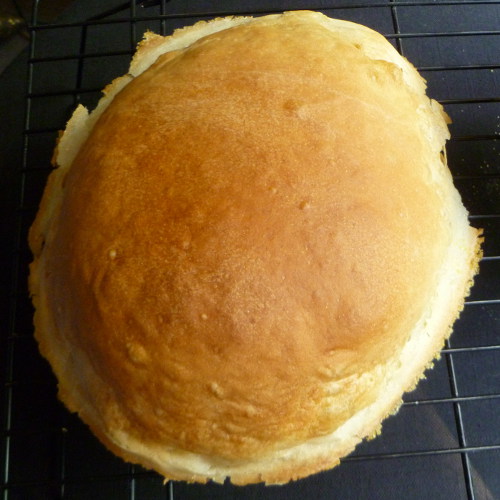
| The control loaf, risen normally. |
I couldn't read something like that and not try it.
The theory is that the bread is ready to be baked when it is floating on top, presumably because that means there's enough air trapped in the dough.
Allegedly, if you drop a lump of dough into water, the whole loaf you have formed will be ready for the oven when the lump floats.
Before I tried this experiment, that test made sense. Now, I can see some flaws in the theory.
Andrew Whitley, the author of Bread Matters, said that he tried the method but found that handing a slippery loaf of wet bread was too annoying. That wasn't enough to deter me.
 |
| The water-risen test loaf. |
I have no idea what river that was or how warm or cool it was in summer, but I went for something a little cooler than room temperature.
And there was no mention of what type of bread was being dropped into that bucket of water, but from what Whitley said, it was more of a general tip for new housewives who needed help with bread making.
With that little bit of information, I carried on with the experiment. I made a batch of my basic, everyday bread with no frills except that I substituted whey for the water because I had whey on hand from making yogurt. I let it rise once as usual. Then I divided my dough in half. The plan was that I'd use the water-rising dough as my gauge for when both loaves were ready to bake.
Plans don't always work.
Here's the half of the dough when in went into the water.
It sank right to the bottom, just like it was supposed to.

But, uh oh, it started floating almost immediately.
No one told the bread that it was supposed to stay on the bottom.
No one told the bread that it was supposed to stay on the bottom.

I knew it wasn't ready for baking in just a minute or two and I thought that maybe the clue was that it should float a little higher rather than just bobbing about on the surface. It started looking lighter and floating higher, but the dry loaf wasn't ready. They were supposed to finish at the same time, so I let them go for a little while longer. The dough did float even higher, but it also flattened out quite a bit. My bobbing beach ball looked more like an island.
Here is its, floating high:

It was pretty wet and a little gooey on the bottom.

For comparison, here's the dry loaf:

But what they heck, I had them made, I figured I'd bake them both even though the wet one looked pathetic. The dough equivalent of a wet cat. The wet loaf rose in the oven better than I expected, but it was a little weird around the bottom and it stuck to the pan a bit.

Here are the two loaves, top-down:

It's not terrible, but it doesn't have the same perky roundness of the dry-risen loaf.
Here's another view.

And last, here is a photo of the sliced loaves. They were baked side-by-side in the oven for the same amount of time. You can see how the bottom of the water-risen loaf sort of melted as it baked. The missing gaps on the bottom of the loaf are where the bread stuck to the baking pan. Parchment paper might have helped.

Volume-wise, they're probably pretty close. The water-risen one is definitely wider, but it's not as tall as the standard loaf.
Needless to say, timing the rising based on what was going on with the water-risen loaf didn't work. If I was going by look and feel, I would have left the dry one for another five or 10 minutes. And the wet one should have come out of the water sooner.
Even though this wasn't a rip-roaring success, I think it's a method that's worth investigating further. Next time, I'm going to assume that the river water is colder, and I'm going to take it out of the water when it's still a nice ball rather than gooey and melted on the bottom. I might also experiment with dryer doughs to begin with, and see if that makes any difference.
This has been submitted to YeastSpotting.
