Last night I was watching a re-run of Hawaii 5-0 and the plot revolved around a surfer who was murdered. At the end of the show, a bunch of surfers paddled out into the ocean and formed a circle and spread the ashes of their deceased friend.
For me, it was a completely foreign ritual, and also very moving.
Particularly because a friend of mine had died suddenly, and I've been a bit weepy.
I started thinking about the rituals we have in our different cultures. Our religions and our ethnic groups and even our geographical locations dictate what sort of things we do when a friend or loved one dies, ranging from the mournful playing of a bagpipe, to a 21-gun salute at a military funeral, to the joyous celebration of life as it's done in New Orleans.
In those instances, mourners gather together to comfort each other in a way that is familiar to them. Different cultures have developed different rituals, but the purpose is the same. They help people move beyond the grieving to the point where they can think of their loved one with a smile and a fond memory.
Besides the usual geographic and familial cultural groups I'm a part of, I also belong to relatively new and unique culture. It spans many religions and nationalities and pays no attention to geography. We're a loosely connected and firmly knotted group of people who go online and bond over food and fun. We talk every day. We laugh, celebrate, kvetch, and sometimes cry. We are close friends, even though many of us have never met in person.
But when one of us dies, the rest of us can't hug or hold hands or perform rituals together. We can't eat funeral potatoes or hot dish or go to that one restaurant where everyone goes after a funeral. We're a new sort of tribe, we don't have those generations-old traditions, and we're not geographically close enough to get together for happy or sad events.
The funny thing is that new rituals have emerged, all by themselves. I guess people need a way to bond and celebrate the lives of those who have touched us. With our group, we talk about our friend's favorite food or their signature recipe. We choose a time to raise a glass in a tearful toast. We make their recipes. We post photos. And we are comforted because we know that despite the distance between us, we have a bond.
 |
| Don't those Fritos look happy in their chili and cheese spa? |
And I got a dozen or so answers. I looked it up on the Frito website. I asked more people. The only constants in the recipes were Fritos
 , chili, and cheese. Canned chili was a popular choice, with Wolf brand being a favorite among the Texans in the group, since it's a Texas product.
Some people put the chips on the chili, other people put the chili on the chips. Some people mixed it all up in a small bag of Fritos and ate it straight from the bag, and others put it in a casserole dish. Some people ate it with a fork or spoon. Some people layered it. Others mixed it. Some baked it and some didn't. And then there were toppings.
I was confused. It sounded like a cross between nachos and chilaquiles, but with chili and Fritos.
And then someone said that it doesn't matter - just make it the way you like it.
That totally sounded like what Chris would say, because she really liked to change or modify recipes to make them her own. When presented with the challenge to make a recipe from my cookbook, she turned blueberry and cream cheese sweet rolls into candied jalapeno and cream cheese rolls. I was totally impressed.
So I embarked on my Frito Pie adventure knowing that whatever I did would be okay.
My first attempt was with Fritos on the bottom, chili on top, followed by cheese. I baked it to melt the cheese, and topped it with onion, tomato, sour cream, and jalapenos. It was good, but I had leftover chili, so I decided to try something different for lunch the next day.
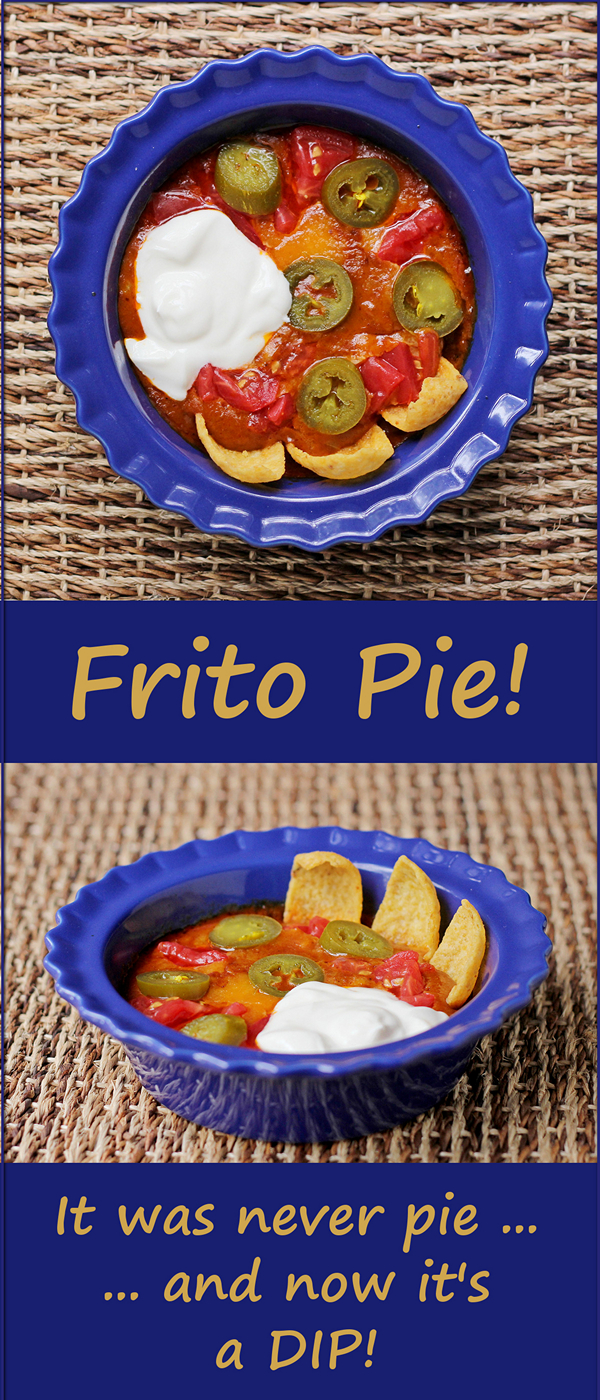
I didn't want to turn the oven on for a lunch portion, so I turned Frito Pie into a dip. I used a mini pie plate - hey, it's called pie, so why not - and put the chili and cheese in the microwave to warm them. And I scooped it up with crisp Fritos. Totally not like what anyone else told me to do.
Oh, and since I'm a midwesterner rather than a Texan, I used chili with beans. Apparently Chris was okay with that, too.
This one's for Chris!
Frito Pie


Shredded cheddar cheese
Chopped onions
Chopped tomatoes
Pickled jalapenos
Sour cream
Fritos
For a single serving, put the chili (as much as you think is one serving!) in a microwave-safe bowl, and add the cheese. As much cheese as you like. If you want to take a little of the "bite" out of the onions, you can add them as well.
Microwave on high for 30 to 60 seconds, until the chili is hot and the cheese is melted.
Add onions (if you didn't add them before cooking) tomatoes, jalapenos, and sour cream.
Use Fritos to scoop up the chili. I nestled three into the dish for photos, but grabbed chips from the bag for the rest of the scooping. Remember, there's no wrong way to do it!
Have you had Frito Pie? How do you like yours?